How Floor Prices Impact DSP Performance in Programmatic Advertising

Floor prices play a far greater role in programmatic performance than many advertisers assume. While brands often focus on audience targeting, frequency, and creative optimization, the minimum price set by the supply-side platform quietly shapes the entire auction environment. A higher or poorly calibrated floor can restrict bid participation, suppress win rates, and limit access to valuable impressions. Conversely, a well-aligned floor price can stimulate competiti
on, stabilize clearing prices, and improve overall campaign efficiency.
Since auction economics drive programmatic buying, floor prices serve as a core market signal rather than just a technical setting. Floor pricing directly influences which DSP bids qualify, how algorithms learn, and how budgets allocate across exchanges. When demand misaligns with floors, DSPs often shift their spending to other channels, which reduces scale and performance. Therefore, advertisers should treat floor pricing as a strategic lever that directly affects delivery, cost efficiency, and the long-term optimization potential of their programmatic campaigns.
How Floor Prices Interact with DSP Algorithms
DSP bidding algorithms rely on probability models to determine how much to bid for each impression. These models estimate the possibility of a desired outcome, such as a click, conversion, or incremental revenue, and translate that likelihood into a bid aligned with target CPA or ROAS goals. The calculation assumes relatively stable auction conditions. When floor prices fluctuate unpredictably across exchanges or inventory segments, the relationship between predicted value and clearing price becomes harder for the algorithm to learn.
Frequent or opaque floor adjustments introduce noise into the training data that DSP models use to optimize bids. The system may interpret lost auctions as weak performance rather than pricing barriers, leading to overly conservative bidding or misallocated spend. As a result, optimization cycles slow down, and pacing logic may struggle to distribute budgets evenly throughout the campaign.
Stable and transparent floor pricing creates a more predictable auction landscape. This allows DSP algorithms to refine bid shading strategies, improve win probability modeling, and pace budgets with greater precision. In consistent environments, probability-based bidding performs as intended, since the algorithm can accurately connect impression value with expected cost. Over time, this stability leads to more efficient learning, stronger delivery patterns, and improved overall campaign performance.
The Hidden Cost of Aggressive Floor Strategies
Aggressive floor pricing strategies often appear attractive because they promise higher CPMs and stronger short-term revenue. In practice, however, excessively high or frequently changing floors can reduce the number of bids entering the auction. DSP algorithms are designed to operate within defined value thresholds. When the minimum price consistently exceeds the predicted value of an impression, the system simply withdraws from the auction rather than increasing it. This behavior reduces bid density and weakens competitive pressure.
Lower participation creates auction friction, leading to fewer bids and less effective price discovery. This increases the likelihood that impressions will remain unsold or clear at unstable prices. What looks like price control can quickly turn into delivery loss, lower fill rates, and fragmented demand patterns. Over time, buyers may redirect spend toward more predictable inventory sources where algorithms can learn efficiently and compete with confidence.
The table below summarizes how different floor pricing strategies impact key auction and campaign metrics, highlighting the trade-offs between short-term gains and long-term efficiency.
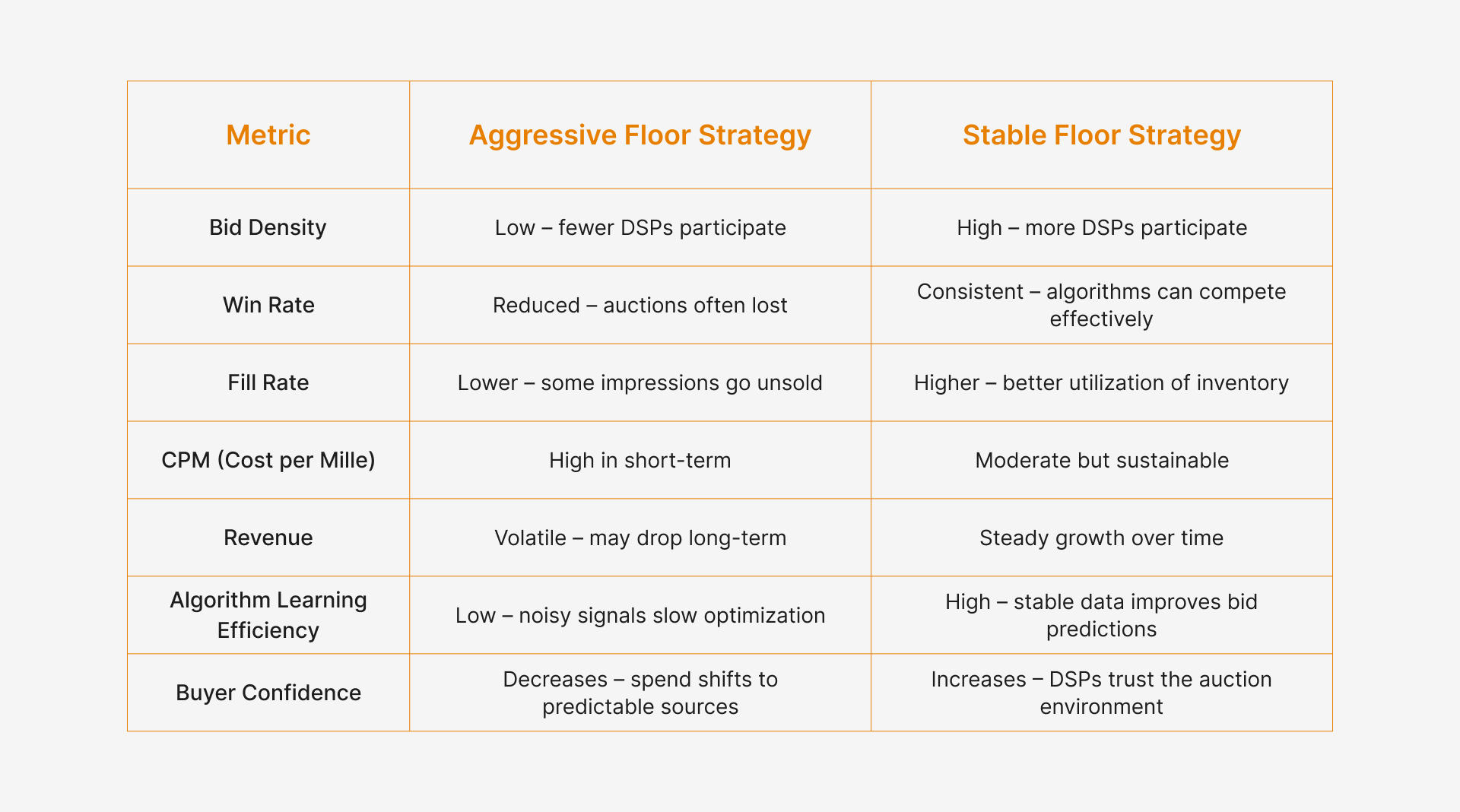
The long-term effect is often counterproductive. Rather than increasing yield, aggressive floor policies can shrink the pool of accessible demand and reduce total revenue. Sustainable monetization typically comes from balanced pricing that preserves auction liquidity while still protecting inventory value. In this sense, floor strategy is not just about setting a price but about maintaining a healthy and competitive marketplace.
Why Stable Supply Improves Campaign Efficiency
Stable supply conditions are essential for efficient programmatic buying, and floor pricing plays a central role in creating that stability. When minimum prices remain stable over time and across inventory segments, DSP algorithms can more accurately map impression costs to expected performance. This improves bid accuracy by learning how much value each traffic source generates relative to its clearing price. As a result, win rates become more consistent, and campaigns deliver more smoothly.
Predictable floors also strengthen optimization loops. When pricing shifts sharply, DSP models must constantly reinterpret auction losses and recalibrate their bidding logic. This slows learning and introduces volatility into pacing and budget allocation. In contrast, a stable pricing environment allows algorithms to refine probability estimates, adjust bid shading with confidence, and allocate spend toward inventory that reliably meets performance targets.
From an economic perspective, stability typically outperforms short-term revenue spikes driven by sudden price increases. While temporary floor hikes may boost CPMs in isolated moments, they often disrupt demand patterns and reduce long-term efficiency. Stable supply encourages sustained buyer participation, deeper competition, and more accurate valuation of impressions. Over time, this leads to stronger campaign outcomes and more durable revenue growth for sellers.
Aligning SSP and DSP Incentives
Efficient programmatic markets depend on alignment between supply and demand-side incentives. When SSP pricing strategies reflect how DSP algorithms evaluate value, auctions function more smoothly and competitively. Floor prices that are informed by real demand signals help ensure that impressions remain accessible to buyers whose models predict strong performance. This alignment increases participation, improves price discovery, and supports more stable campaign delivery.
Collaboration plays a key role in achieving balance, as it fosters transparent communication about pricing logic, structured testing of floor adjustments, and shared performance insights. This mutual understanding helps both sides comprehend how auctions respond to change. Instead of relying on short-term revenue tactics, publishers can use data-driven experimentation to identify pricing levels that maximize long-term yield without reducing demand.
Decreasing uncertainty across the supply chain benefits everyone involved. DSPs gain a more predictable environment for optimization, while SSPs benefit from stronger competition and more consistent fill. When goals are aligned and information flows more openly, auctions become more efficient, budgets are spent more effectively, and the overall health of the programmatic ecosystem improves.
Building a Sustainable Auction Environment
Bid floors are more than a revenue lever for publishers, they are a critical mechanism for balancing the programmatic marketplace. When set thoughtfully, floors create predictable conditions that allow DSP algorithms to evaluate impressions accurately and bid efficiently. This predictability fosters competition, improves win rates, and supports smoother budget pacing.
Sustainable growth in programmatic advertising relies on stable auction mechanics, aligned supply- and demand-incentives, and economically rational pricing strategies. Sudden floor spikes may produce short-term revenue gains, but they introduce volatility that disrupts DSP optimization, reduces bid density, and undermines long-term efficiency.
By prioritizing stability and transparency, both SSPs and DSPs benefit. Publishers maintain access to competitive demand, while buyers can optimize campaigns with confidence. Over time, a sustainable auction environment strengthens relationships, maximizes yield, and ensures that programmatic advertising delivers predictable, efficient, and profitable outcomes for all participants.
The power of programmatic

The Scale of the Problem in Modern RTB Bid request failures in real-time bidding are not merely isolated incidents or technical errors, but rather a systemic problem inherent in the functioning of contemporary programmatic advertising. RTB processes enormous volumes of data every second, involving countless auctions, signals, and integrations across the ecosystem. At this scale, even a minor inefficiency can quickly multiply into serious consequences. Missed bids, malformed requests, or slow responses can lead to lost impressions, wasted infrastructure costs, and revenue that never materializes.

The Role of Generative AI in Programmatic Advertising

AdTech Landscape Evolution Beyond Google
11 Dec 2025AdTech Landscape Evolution Beyond Google Imagine an AdTech world where Google is no longer the only gatekeeper. New channels and independent platforms are giving advertisers fresh ways to reach audiences with precision and privacy. Connected TV, in-app environments, and retail media networks are unlocking unique inventory and data models outside traditional ecosystems.