The Role of Generative AI in Programmatic Advertising

The Role of Generative AI in Programmatic Advertising
Why Generative AI Matters in Programmatic
Programmatic advertising has grown far more complex than the systems that first powered it. Brands now manage thousands of signals across formats, devices, and media environments, while audiences shift constantly and expectations for relevance keep rising.
Unlike traditional automation, which follows predefined logic, generative models learn patterns, generate insights, and adapt creative and media decisions in real time. This capability is critical as channels fragment, data volumes expand, and campaign variables multiply. Teams are under pressure to plan, optimize, and personalize faster, often with limited human oversight.
Older automation tools struggle to keep pace because, while they execute tasks efficiently, they lack the flexibility to reason across data, predict outcomes, or create new options. Generative AI fills this gap, turning programmatic platforms into systems that can think, not just execute.
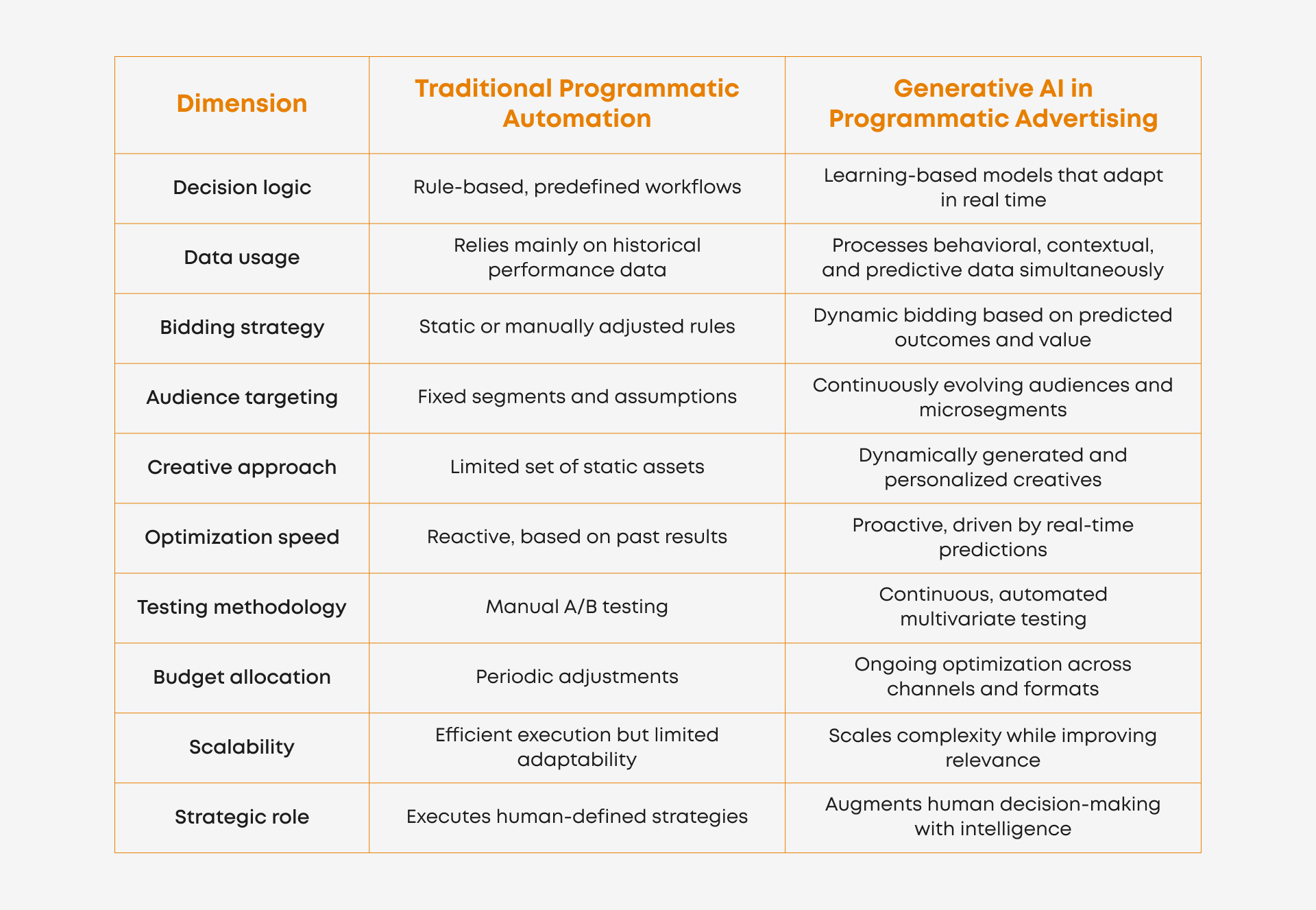
From Automation to Intelligence in Media Buying
For years, programmatic advertising has relied on automation to manage bidding, targeting, and delivery at scale. These systems excel at executing predefined rules, but they remain limited by the logic and assumptions built into them. Generative AI represents a shift from execution to intelligence, enabling media buying systems to learn, reason, and adapt continuously.
Generative AI models can process vast volumes of behavioral, contextual, and performance data in real time. Instead of reacting only to past outcomes, they predict how different variables are likely to perform under changing conditions. This allows platforms to refine bidding strategies dynamically, adjusting bids based on probability of conversion, expected lifetime value, or shifting market demand. Targeting also becomes more flexible, with audiences evolving as models identify new patterns and value segments.
This predictive capability leads directly to stronger campaign performance. Ads are delivered where they are most likely to generate impact, reducing wasted impressions and improving key metrics such as conversion rates and ROAS (return on ad spend). At the same time, budgets are allocated more rationally across channels, formats, and audiences, guided by continuous learning rather than static assumptions.
Generative AI in Creative Optimization and Personalization
Generative AI is transforming how advertising creatives are produced, tested, and delivered within programmatic environments. Instead of relying on a limited set of static assets, advertisers can now generate and adapt creative elements at scale, responding to audience signals in real time. This makes the creative strategy more flexible, data-driven, and closely aligned with user intent.
Key ways generative AI enhances creative optimization include:
- Dynamic creative generation
AI models can automatically produce multiple versions of headlines, visuals, calls to action, and layouts. These elements are assembled dynamically based on audience data, context, and placement requirements.
- Personalized messaging
Generative AI tailors messages to individual users or microsegments by incorporating behavioral signals, location, device type, and previous interactions. This ensures messaging feels relevant rather than generic.
- Rapid creative testing
Instead of manual A B testing, AI can continuously test variations across formats and audiences, learning which combinations perform best and scaling them quickly.
- Adaptive format optimization
Creative assets are adjusted to fit different channels, from display and video to native and social placements, without additional production effort.
As a result, users are shown creatives that better match their interests and intent. This relevance drives higher engagement, improved conversion rates, and stronger overall campaign performance, while reducing creative fatigue and production costs for advertisers.
Smarter Decision-Making Through Predictive Analytics
Predictive analytics represents one of the key advancements that generative AI brings to programmatic advertising. As campaigns grow more complex, making informed decisions requires more than historical reporting. AI-driven predictive models enable advertisers to look ahead, improving planning accuracy.
Analyzing large volumes of performance, audience, and contextual data, these models forecast how campaigns are likely to perform under different conditions. Advertisers can estimate future reach, conversion rates, and return on ad spend before committing budgets. This supports more confident media planning and helps teams prioritize channels, formats, and audiences with the highest expected impact.
Predictive analytics is key to detecting anomalies, as AI can spot unusual patterns such as sudden performance drops, rising costs, or unexpected changes in audience behavior. These signals are detected early, often before they become visible in standard dashboards. As a result, teams can investigate issues and make adjustments before escalating.
Perhaps most importantly, predictive insights allow strategies to be refined proactively. Bidding logic, targeting criteria, and creative emphasis can be adjusted based on anticipated outcomes rather than solely on past results. Such an approach leads to more stable performance, reduced waste, and more aligned campaigns with evolving market conditions.
Privacy, Transparency, and Brand Safety Considerations
As programmatic advertising evolves, concerns around privacy, trust, and brand safety have become central. When implemented responsibly, generative AI can support these priorities rather than undermine them. Current AI models can support privacy-friendly targeting by leveraging contextual information, aggregated data, and predictive patterns rather than relying on individual identifiers. This approach helps advertisers remain effective while aligning with data protection regulations and user expectations.
Generative AI also strengthens fraud detection and inventory quality control. By continuously analyzing traffic patterns, placement behavior, and performance anomalies, AI systems can identify invalid traffic, unsafe environments, and low-quality inventory more quickly than manual review processes. This reduces wasted spend and protects brand reputation.
However, these benefits depend on transparency and strong governance. Advertisers need clear visibility into how AI models make decisions, what data sources are used, and how outcomes are evaluated. Clearly define controls, regular audits, and human oversight are essential to ensure fairness, accountability, and alignment with brand values. Without transparency, even advanced AI systems risk eroding trust within the programmatic ecosystem.
What Generative AI Means for the Future of Programmatic
Generative AI is reshaping the future of programmatic advertising by turning campaigns into adaptive, data-driven systems. Advertisers and platforms that embrace these technologies gain a competitive advantage through faster decision-making, more precise targeting, and continuous optimization of creative and media strategies. AI enables campaigns to respond in real time to audience behavior, market trends, and contextual signals, improving efficiency and effectiveness while reducing waste.
Looking ahead, the role of generative AI will expand as models become more sophisticated and integrated across the advertising ecosystem. Success will depend on combining technological capabilities with strong data governance, transparency, and strategic oversight. Brands that prioritize adaptability, quality data, and intelligent automation are likely to lead in a landscape defined by speed, relevance, and measurable impact.
The power of programmatic

Floor prices play a far greater role in programmatic performance than many advertisers assume. While brands often focus on audience targeting, frequency, and creative optimization, the minimum price set by the supply-side platform quietly shapes the entire auction environment. A higher or poorly calibrated floor can restrict bid participation, suppress win rates, and limit access to valuable impressions. Conversely, a well-aligned floor price can stimulate competiti

The Scale of the Problem in Modern RTB Bid request failures in real-time bidding are not merely isolated incidents or technical errors, but rather a systemic problem inherent in the functioning of contemporary programmatic advertising. RTB processes enormous volumes of data every second, involving countless auctions, signals, and integrations across the ecosystem. At this scale, even a minor inefficiency can quickly multiply into serious consequences. Missed bids, malformed requests, or slow responses can lead to lost impressions, wasted infrastructure costs, and revenue that never materializes.

AdTech Landscape Evolution Beyond Google
11 Dec 2025AdTech Landscape Evolution Beyond Google Imagine an AdTech world where Google is no longer the only gatekeeper. New channels and independent platforms are giving advertisers fresh ways to reach audiences with precision and privacy. Connected TV, in-app environments, and retail media networks are unlocking unique inventory and data models outside traditional ecosystems.